Choose a coffee grinder for espresso by the adjustments you can use with your machine and basket, the dose you can repeat and the way you collect the grounds. Reaching a fine setting is necessary for many espresso preparations, but it does not establish that a grinder can make useful changes around your preferred recipe.
A good buying decision starts with your equipment and routine. Record the machine, basket, intended coffee dose and number of drinks you make together. Then compare the controls and handling that support that task. A larger burr, more settings or a built-in scale can describe a feature without answering whether the whole preparation suits you.
What makes a coffee grinder suitable for espresso?
An espresso grinder must provide a usable working range for the coffee and equipment you intend to use. The National Coffee Association's espresso guide recommends fine grinding as a starting point and adjusting as needed. The next buying question is whether you can make a useful change within that range and recover a setting you liked.
Match the grinder to the machine and basket
Check which basket your machine uses. A non-pressurized, or single-wall, basket has a perforated base through which the drink exits. A pressurized, or dual-wall, design adds an outlet restriction. That difference changes the brewing system you are evaluating, so record the basket type rather than treating every portafilter setup as the same test.
Use the basket and dose recommended for your machine. A demonstration with a pressurized basket does not establish how the same grinder performs with a different non-pressurized basket. If you plan to change baskets, include the intended combination in the comparison before buying.
On a small screen, scroll the diagram horizontally to compare the two constructions.
Define the routine before the specification
One drink on a quiet morning creates a different task from several drinks prepared together. Note whether you change coffees, want powered grinding or also brew filter coffee. These choices help you judge loading, adjustment access and grounds collection. For the wider mechanism and power choices, use our coffee grinder buying guide.
How much grind adjustment does espresso need?
You need a range that reaches your recipe and adjustments that are useful near the working position. A grinder can reach a sufficiently fine setting yet move too far between adjacent positions for a particular recipe. Count the settings you can use for that task, rather than assuming a large total count settles the question.
Range and adjustment increment answer different questions
Range describes the positions available. Adjustment increment describes the change between positions. Neither a numbered dial nor a total setting count specifies the particle-size distribution produced at each position. A stated burr movement in micrometres, where verified, is also different from a measured change in ground-particle diameter.
If neighbouring settings move a fixed-dose shot from excessive flow to restricted flow without a usable position between them, adjustment resolution becomes a practical limitation. Check this with the intended coffee, machine and basket, keeping dose and beverage target steady. Do not compensate by changing several preparation variables and then assume the grind adjustment has been verified.
Stepped versus stepless adjustment
A stepped control has defined positions; a stepless control allows positions between fixed stops. Either needs markings or another practical reference for returning to a recipe. Stepless adjustment can offer more freedom to position the control, but it does not automatically make a grinder easier to set, more repeatable or suitable for every espresso system.
Check the return operation
Follow the model's procedure for adjustment. Some procedures depend on whether beans are present or the motor is running; do not force a control or copy another grinder's method. Record the original position, make a permitted change and return. Include that return in your brew comparison if you frequently switch coffees or methods.
On a small screen, scroll the diagram horizontally to see the full sequence.
What do burr size and material actually tell you?
Burr specifications describe construction. To judge an espresso burr grinder, connect them to adjustment, mounting, operation and maintenance. A flat or conical label cannot supply a universal flavour ranking, and a larger diameter alone does not establish output speed or service life.

Look beyond the material name
Steel and ceramic identify material choices, but performance depends on the complete grinding system. Ask what was measured if a specification claims lower fines, quieter operation or longer life. The coffee, setting, load and method need to accompany the result.
Keep burrs and blades distinct
A rotating blade in a chamber is a different mechanism from two burr surfaces. A blade described as flat is not a flat burr. If you are comparing those systems, see our burr versus blade explanation.
Grinding finer is not a universal improvement. In Cameron and colleagues' espresso modelling and experimental research, published in Matter, measured extraction yield fell at both very coarse and very fine settings under the studied conditions. The authors identified inhomogeneous flow as an explanation at fine settings. This supports checking the result rather than choosing the finest possible position; it does not prescribe a coarser recipe for every machine.
Single dosing, timed dosing and grind by weight
These terms describe different parts of preparation. Single dosing describes loading a measured amount of beans for one preparation. Timed dosing describes controlling running duration. Weight-based stopping describes stopping against a target mass. They are not three mutually exclusive machine categories.
A timer controls duration
A time setting can be convenient once established, but confirm the collected dose when changing coffee or grind position. A timer does not directly measure the mass in the receiving cup or basket. A cup selector also needs to be interpreted according to the specific machine, rather than assuming its cup number is your espresso dose.
Weight control addresses a dosing requirement
A preset-weight function changes how the grinder stops. Check the tare procedure, receiving container and actual collected grounds against a separate scale. Display resolution is not the same as delivered-dose accuracy. Weight control does not establish the particle distribution or whether the useful adjustment positions suit your basket.

Measure the dose that reaches the basket
Follow the coffee beyond the grinder. If you transfer grounds from a cup, check the final basket dose rather than assuming everything reached it. Grounds left on a cup, funnel or work surface belong to a different part of the preparation from material remaining inside the grinder.
On a small screen, scroll the diagram horizontally to follow the complete path.
Retention, static and grounds transfer
For a single dose espresso grinder, ask how output and retained coffee were assessed. The difference between beans loaded and grounds collected describes the mass balance for a run. It does not identify all the coffee inside the machine or distinguish newly retained grounds from older material released during grinding.
Make a low-retention claim interpretable
Record the starting condition, coffee, dose, setting and any permitted clearing action. If switching coffees is important, ask how exchange or carryover was measured across runs. A result measured after a particular clearing routine may not describe your normal preparation without that routine.
Inspect the whole transfer operation
Check the position of the receiving vessel under the outlet, how easily it lifts out and whether the grounds transfer into your basket without awkward pouring. Portafilter supports and funnels need checking with the actual handle and basket. A support shown in a photograph does not establish compatibility with every diameter or handle shape.

Observe clumping and cleaning without guessing the cause
Visible clumps or grounds adhering to surfaces are worth recording, but they do not by themselves quantify particle uniformity. Follow model-specific cleaning and troubleshooting instructions. Do not add water, strike the grinder or introduce a clearing technique unless the manufacturer permits it for that model.
Manual or electric: which espresso grinder fits your routine?
A manual grinder may be practical for occasional espresso if you accept the full-dose effort. Electric operation can remove that action when preparing repeated drinks. Compare with the beans and fine setting you intend to use, rather than judging a brief demonstration at a filter setting.

Choosing a compact espresso grinder for home
Measure working space as well as the stored footprint. Include clearance to load beans, remove the grounds cup, operate the adjustment and reach the charging or power connection. A small body can still require room around it for preparation and cleaning.
Can one grinder serve espresso and pour over?
Possibly, if its working range and adjustment suit both recipes. Compare each method separately and check the return operation after switching. A range described as fine to coarse is not enough to establish the effort or accuracy of changing between your two preferred recipes.
For several drinks together, include preparation frequency and operating limits. A hopper holding multiple doses does not, by itself, establish continuous-duty capability. Rechargeable operation adds charging and operating-mode checks; mains-powered versions need the appropriate regional electrical specification.
How to check an espresso grinder before buying
Use the intended coffee, machine and basket to make the comparison meaningful. Start with the basket manufacturer's dose guidance and your machine's operating instructions. Keep preparation consistent, then change one grinder setting rather than changing dose, grind and beverage target together.
Separate dose, beverage mass, time and extraction yield
For an illustrative 18 g dose and 36 g beverage target, the brew ratio is 1:2 by mass. This is a calculation, not a recipe requirement for every basket or coffee. Record shot time using consistent start and stop events; starting at pump activation and starting at first liquid are different definitions.
Extraction yield describes the fraction of dry coffee mass extracted into the drink. It is not established by timing the shot or weighing the drink alone. Keep a tasting and operation comparison separate from a laboratory claim about extraction or particle distribution.
-
Define the baseline
Record the coffee, machine, basket, intended dose, beverage target and timer events. Follow the machine and grinder instructions for preparation and adjustment.
-
Prepare setting A
Grind and check the dose that reaches the basket. Prepare the shot using your normal consistent method. Record beverage mass, defined shot time, taste and any handling problems.
-
Compare one permitted change
Move to a nearby permitted setting B. Keep coffee, basket dose, beverage target and preparation consistent. Compare the resulting shot and the work required to prepare it.
-
Return and repeat
Return to A using the model's procedure. Repeat the baseline and investigate unexpected differences before attributing them to the grinder. Extend the comparison with repeated runs when evaluating a purchasing requirement.
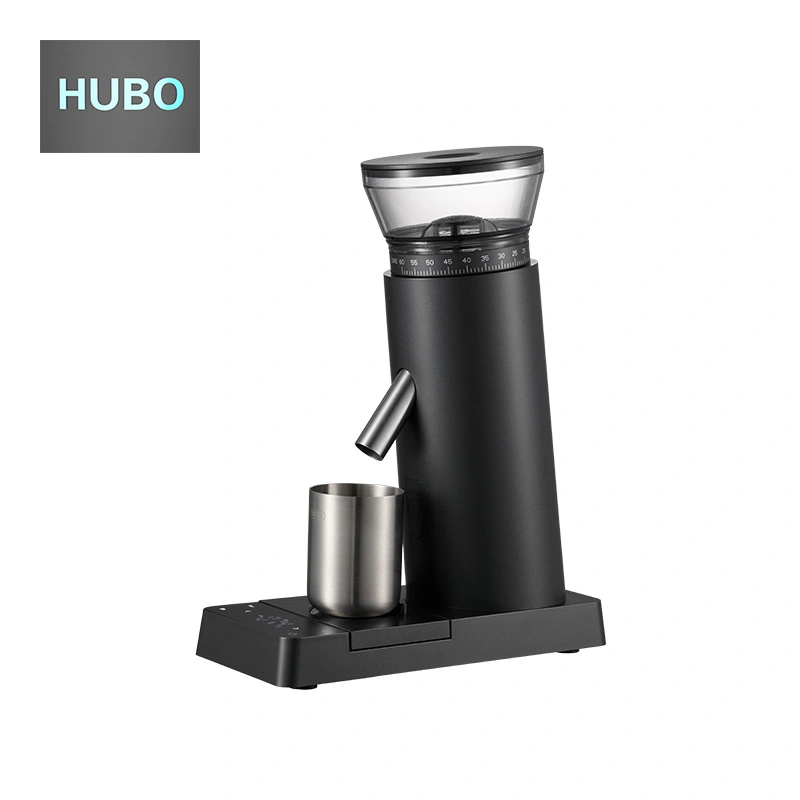
For espresso, usable adjustment near the working setting matters more than the total number of settings. The HUBO HB-683 specifies a 48 mm SUS420 stainless steel conical burr and 25 settings; these describe its construction and adjustment count, but do not establish the adjustment increment or particle-size distribution. The HB-686Pro provides 61 settings and preset-weight stopping, but setting count and dosing automation address separate requirements: neither alone proves finer adjustment in the relevant espresso range.
On a small screen, scroll the table horizontally.
| Field | What to record | Decision it supports |
|---|---|---|
| Equipment | Grinder, machine, basket and receiving accessories | Which combination was actually checked? |
| Coffee and dose | Coffee identity and final basket dose | Was the input held consistent? |
| Adjustment | A, B and return positions; permitted clearing actions | Was the change useful and recoverable? |
| Beverage and time | Drink mass and defined timer events | What happened under the recorded recipe? |
| Preparation and result | Preparation method, taste and handling observations | Does the result and routine suit the user? |
Troubleshoot the shot before replacing the grinder
Use shot behaviour to guide inspection, not to assign a fault from one observation. A fast shot, restricted flow or a flavour you dislike can involve the coffee, basket, dose, preparation and machine as well as the grind setting.
| Observation | Check first | Next action |
|---|---|---|
| The shot runs too quickly | Basket type, actual dose, preparation and selected position | Restore the baseline; compare one permitted grind change |
| The shot barely flows | Dose suitability, grind position, basket condition and machine instructions | Review the preparation before continuing to grind finer |
| Shots vary at the same position | Basket dose, coffee changes, preparation and allowed clearing routine | Repeat recorded conditions and compare again |
| Taste is unexpected | Coffee, drink ratio and preparation, alongside time | Compare one variable; avoid treating sour or bitter as a single-cause diagnosis |
| The grinder stalls or adjustment jams | Permitted load, adjustment procedure and troubleshooting instructions | Stop forcing operation and seek service if the issue persists |
Research does not justify a universal finer-or-coarser rule for every symptom. The Matter study's model and experiments distinguish idealized homogeneous flow from the behaviour measured at fine settings. For a buying decision, the useful lesson is to hold conditions steady and compare the actual response, rather than infer performance from the dial alone.
Compare HUBO configurations for your espresso setup
Use published specifications to shortlist controls, then confirm their suitability with your intended recipe. The following table compares configurations; it does not assign a taste score or establish compatibility with every espresso basket.
| Model and source | Published details | What to check |
|---|---|---|
| HB-683 | 48 mm SUS420 conical burr; 25 settings; 250 g bean hopper; time and cup controls | Working fine positions, neighbouring adjustments, collected dose and actual portafilter fit |
| HB-686Pro | Stainless steel conical burr; 61 steps; preset-weight stopping; rechargeable operation; 60 mL grounds container | Usable recipe adjustment, tare procedure, delivered dose and transfer into the basket |

The HB-683's time/cup selection and the HB-686Pro's target-weight stopping answer different control requirements. If you choose by a weight target, verify collected mass independently. If you choose by adjustment, compare the relevant positions rather than assuming 61 steps must be better than 25 for every recipe.
Also check cleaning before purchase. The HB-686Pro instructions allow washing its bean hopper and powder container, while the main unit is not washable and requires a dry cloth. Do not extend that permission to a different component or model.
What should brands and importers specify before sample approval?
For a factory sample discussion, we recommend naming the intended machine, basket and preparation first. “An espresso grinder for home” leaves the working dose, adjustment task and grounds transfer unclear. State how the customer will load, adjust, collect and prepare the coffee.
Separate functions from acceptance limits
Functional checks establish whether loading, controls, return adjustment, grounds collection and permitted cleaning work as intended. Measured acceptance limits need more detail: target dose, scale, repetitions and operating conditions for dosing; method and reported size distribution for particle measurements. Agree the method before comparing numbers.
If adjacent positions cannot support the required recipe, record that finding for the actual setup. Do not generalize a result from one basket or coffee into a claim about every espresso preparation. Include the exact supplied version, accessories and destination electrical requirements in the sample brief.
Evaluate cost against a defined task
For procurement, a hypothetical 50% purchase-price premium requires 1.5 times as many acceptable grinding cycles to equal the lower-priced option's acquisition cost per cycle, assuming identical batch sizes and operating costs and excluding financing. This multiplier is a break-even criterion; service-life improvement requires matched endurance testing with a defined failure threshold.
Define an acceptable cycle before testing: the machine must still perform the agreed task and meet the agreed limits. A bulk order of household grinders does not turn that model into commercial-duty equipment. For a coffee shop or repeated service, evaluate operating load, cooling and servicing requirements for the actual application.
Espresso grinder questions before buying
Can a regular coffee grinder be used for espresso?
It may be suitable if its working range and adjustments support your machine, basket and recipe. Check nearby positions at a fixed dose and beverage target. A fine label or a high total setting count alone does not establish suitability.
Do I need a stepless grinder for espresso?
Not necessarily. A stepped grinder can suit a recipe when its available positions provide useful control. A stepless grinder offers positions between fixed stops but still needs practical markings and repeatable operation. Compare the actual adjustment near your working setting.
Are more grind settings always better?
No. The total count does not tell you how much changes between positions in the espresso range. Check whether the available positions let you adjust your recipe and return to a previous result.
Can a manual grinder make espresso?
A manual grinder can be suitable if its fine range and adjustment support the intended recipe. Include a full-dose handling check with your coffee. The effort and time must also suit the number of drinks you prepare.
Is grind-by-weight necessary for home espresso?
No. You can establish a recipe with a separate scale and a suitable manual or timed grinding routine. Preset-weight stopping can change the number of stopping actions, but its delivered dose still needs checking under the intended conditions.
Can one grinder handle espresso and pour over?
Yes, if its working range and adjustment suit both recipes and switching is practical. Check both methods and the return to the espresso position. A broad fine-to-coarse description alone does not establish that the switching routine works for you.
Does a larger burr guarantee better espresso?
No. Burr diameter describes one part of the construction. Evaluate the complete grinder, including useful adjustment, dose control, grounds transfer and the result with your equipment. Larger diameter alone does not establish flavour, precision or service life.
For a configuration or sample discussion, contact Ningbo Hubo Electrical Appliance Co., Ltd. with your machine, basket, intended dose, use frequency and candidate model. Email sales@nb-hubo.com or call +86-574-87271973.
Choose the grinder around a recipe you can adjust and a preparation you can repeat. Check the basket dose, compare a controlled change and follow the grounds into the portafilter. Those observations give a specification list a practical meaning.